
The following sections list every released version of Orchestrator, newest first. Each section comes from the monthly OCP® Release Notes page named in its Released line.
Orchestrator 1.37.4
Released: October 2026
|
US1 |
US2 |
EU1 |
|---|---|---|
|
October 27, 2026 |
Rolled-forward |
November 3, 2026 |
New Features
-
Agent limits on the Re-Ask node in OCP Console - A Re-Ask node in router mode can set its own Max. consecutive no-input attempts and Max. human agent requests (1 to 10), overriding the agent's defaults for that step. Left empty, the agent's defaults apply as before.
Fixed
-
Event handlers configured on an agent fail source now trigger at runtime.
-
Re-Ask nodes in router mode no longer compile with an extra Intent input that the agent does not expect.
-
A Re-Ask node in router mode reached through branches on its routing parameter now runs instead of never firing.
Orchestrator 1.37.3
Released: October 2026
|
US1 |
US2 |
EU1 |
|---|---|---|
|
Rolled-forward |
Rolled-forward |
Rolled-forward |
New Features
-
Agents in subflows in Advanced Agents Configuration in OCP Console® — The Advanced Agents Configuration drawer now lists agents placed in subflows as well as in the main app, so they can be configured from the same place.
Orchestrator 1.37.2
Released: October 2026
|
US1 |
US2 |
EU1 |
|---|---|---|
|
October 15, 2026 |
October 21, 2026 |
October 21, 2026 |
New Features
-
Streamlined Concierge v2 Agent Setup in OCP Console® – Configuring a Concierge v2 agent is now quicker and easier to scan. Policies, Conditional Logic, Constraints, and Error Handling are grouped into expandable sections you open one at a time, so you no longer scroll past empty fields. A summary view lets you jump straight to any section to update it.
Orchestrator 1.37.1
Released: September 2026
|
US1 |
US2 |
EU1 |
|---|---|---|
|
October 12, 2026 |
Rolled-forward |
October 13, 2026 |
New Features
-
Automatic Routing for Silent Callers — Applications can now recognize callers who never provide any input during a call and automatically route them to a transfer or exit action, reducing dead-air interactions and giving non-responsive callers a clear next step instead of stalling in the dialog.
-
Model-Aware Text-to-Speech Voice Selection — Voice selection now factors in each voice's underlying speech model and quality tier, giving a clearer view of available text-to-speech options when configuring an application. Selecting a premium or exclusive voice prompts acceptance of the applicable terms before it can be used. Voice behavior stays consistent even as detection of streaming-capable voices continues to improve behind the scenes.
Fixes
-
Reliable Tool Deployment for Agents — Tools attached to an agent now deploy with their full configuration intact. Previously, some tools could lose key identifying information during deployment, so they no longer worked as expected. Configured tools now function correctly right after deployment.
-
Reliable Application Import — Fixed an issue where importing an application that includes a global Natural Language Understanding override on an OCP miniApps® component could fail with an error. These applications now import successfully every time.
Orchestrator 1.37.0
Released: September 2026
|
US1 |
US2 |
EU1 |
|---|---|---|
|
September 28, 2026 |
September 30, 2026 |
September 28, 2026 |
New Features
-
Fine-Tuned Speech Recognition by Agent and Language - You can now configure speech recognition behavior for each virtual agent and language individually, choosing a recognition grammar, tuning recognition parameters, and boosting important words or phrases so they're recognized more reliably. An app-wide default can also be set so every agent benefits without repeating the same configuration. This gives you finer control over recognition accuracy for specialized vocabulary, reducing misrecognition on terms that matter most to your callers.
Improvements
-
Descriptions for Escalation Queue Guardrail Inputs - When you set a guardrail flow for an escalation queue, its input fields now appear with editable descriptions, making clear what each field expects. This makes escalation queue setup easier to understand and maintain, especially when guardrail flows are reused later.
-
Reliable Condition Settings in the Flow Builder - Editing a condition block with multiple "not equal" comparisons no longer flips all fields to "equal" when you change one field selection. Condition settings now stay exactly as configured, and overlapping dropdown options in the condition editor are also fixed for clearer visibility.
-
Clearer Deployment Errors for Empty Flows - When a deployment fails because a flow has no blocks, the error message now names the specific flow that needs attention, so you can find and fix the issue immediately instead of searching through every flow in the app.
-
Uninterrupted Chat During Theme Switching - Switching the interface theme while a chat window is open no longer closes the chat, so you can change your display preferences without losing your conversation.
Fixes
-
Complete Set of Call Failure Reasons for Error Handling - Three call failure reasons, covering maximum disconfirmation attempts and data model errors or timeouts, were missing from the failure-reason options used to build error handling logic. All valid failure reasons are now available, so you can build complete and accurate error-handling paths for every call outcome.
-
Reliable Rate and Volume Controls for All Text-to-Speech Providers - Rate and volume controls in the text-to-speech configuration screen now display correctly for every voice provider, even when provider details are temporarily unavailable. Amazon voices show the appropriate preset options, and all other providers show adjustable numeric controls, so voice configuration is never left incomplete.
-
Fixed Label Selection When Creating a New App - The app creation window no longer breaks when you select a label while creating a new app.
-
Readable Locale Names in Configuration Dropdowns - Locale selectors across text-to-speech, natural language, and audio configuration screens now show proper, human-readable language names instead of internal codes, with a graceful fallback to the locale code for any language not yet named.
-
Up-to-Date Agent Configuration After Deployment - Deploying an agentic app after updating its instructions or escalation queue now always deploys the latest saved version. Previously, a deployment could reflect the configuration from one save earlier, so recent changes were not immediately live.
-
Consistent Navigation After Deleting an App - Deleting an app while viewing its canvas now redirects you to the applications list, matching the behavior already available elsewhere, instead of showing a "not found" page.
-
Fixed Legacy App Audio Uploads - Uploading audio files for legacy applications no longer fails with a permissions error, so legacy app deployments complete successfully.
-
Reliable Call Exit Handling on Reused Prompts - When a re-ask prompt is reused across multiple conversation branches and a caller declines to continue, the call now correctly routes to the configured exit experience instead of ending unexpectedly. This ensures callers who ask to exit are handled consistently no matter which path led them there.
-
This release includes security updates.
Orchestrator 1.36.4
Released: September 2026
|
US1 |
US2 |
EU1 |
|---|---|---|
|
September 8, 2026 |
September 23, 2026 |
September 14, 2026 |
New Features
-
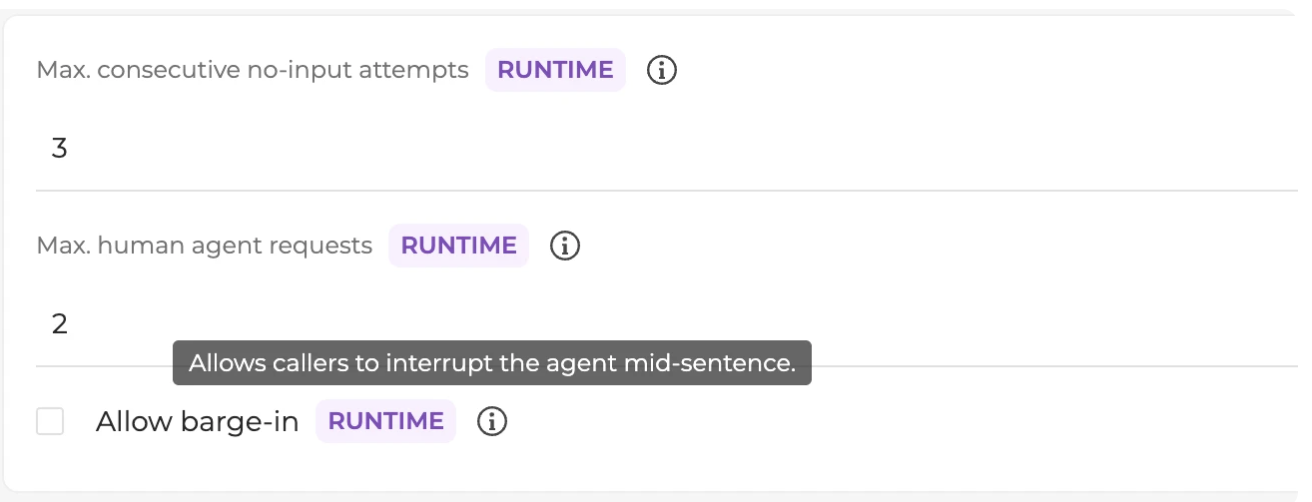
Configurable Barge-In for Agent Prompts - Agent cards now include an "Allow barge-in" toggle, letting callers interrupt the agent's prompt playback and start speaking right away instead of waiting for the message to finish. Turn it on for agents where faster, more natural interactions matter; it stays off by default to preserve existing behavior.
Orchestrator 1.36.3
Released: August 2026
|
US1 |
US2 |
EU1 |
|---|---|---|
|
August 31, 2026 |
September 16, 2026 |
August 27, 2026 |
New Features
-
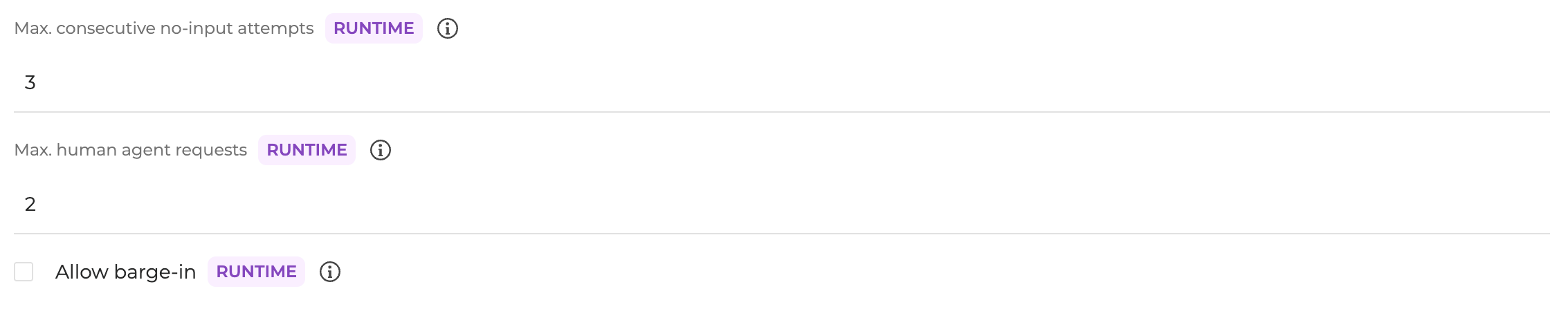
Configurable No-Input and Agent-Transfer Thresholds - You can now control how many consecutive silent responses or agent-transfer requests a caller can make before the conversation ends, directly from the agent configuration. Sensible defaults apply automatically if you don't set your own, and administrators can also disable a threshold entirely by setting it to zero. This gives you finer control over when a conversation ends or escalates, improving the experience for callers who stay quiet or repeatedly ask for a human agent.
-
Longer Agent Descriptions for Better Context - Agent descriptions now support up to 1,000 characters (previously 255), letting you add richer context in the console. More detailed descriptions help the Concierge make more accurate routing decisions among your agents.
Orchestrator 1.36.2
Released: August 2026
|
US1 |
US2 |
EU1 |
|---|---|---|
|
August 10, 2026 |
August 26, 2026 |
August 17, 2026 |
Fixes
-
Restored Volume and Rate Controls in Text-to-Speech Configuration - Some text-to-speech configuration screens stopped showing volume and rate settings for certain locales, so changes could not be saved. Volume and rate controls now display correctly every time, so you can configure them without interruption.
Orchestrator 1.36.1
Released: July 2026
|
US1 |
US2 |
EU1 |
|---|---|---|
|
July 27, 2026 |
Rolled-forward |
July 27, 2026 |
Fixes
-
Reliable Voice Provider Selection in Text-to-Speech Configuration - Organizations using only certain third-party voices previously found the text-to-speech provider list empty, blocking configuration entirely. The provider dropdown now always shows a valid option, so you can configure text-to-speech voices without interruption.
-
Accurate Detection of Chirp Voices - Chirp voices are now identified by their unique identifier instead of by name, ensuring correct voice behavior and features apply consistently even as naming conventions change.
Orchestrator 1.36.0
Released: July 2026
|
US1 |
US2 |
EU1 |
|---|---|---|
|
July 15, 2026 |
Rolled-forward |
July 28, 2026 |
New Features
-
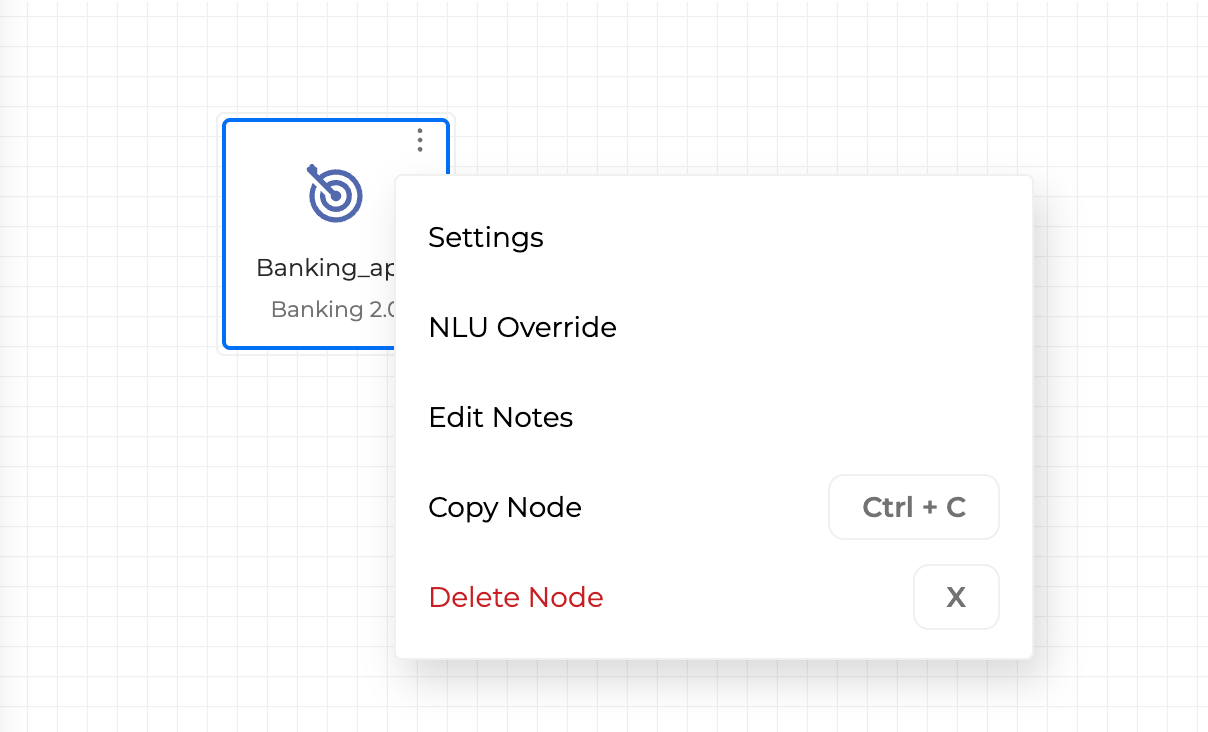
Global NLU Override per Flow and miniApp - The Natural Language Understanding (NLU) model that drives intent recognition can now be configured independently for individual flows and OCP miniApps® on the canvas, overriding the application-level Global NLU setting. This enables multi-domain applications to route each part of the conversation through the most appropriate NLU model, improving recognition accuracy without changing the overall application structure. A new Global NLU setup option is also available directly from an existing application, so you no longer need to recreate an app to enable Global NLU. Application Options Menu
-
Reorderable Node Configuration Fields - Fields within a node's configuration panel can now be reordered manually by dragging them into the preferred sequence. This makes it easier to organise complex node configurations and aligns the layout with the logic of your application.
Improvements
-
Google Chirp Voice Support - Google Chirp voices are now fully supported in the Global Text-to-Speech configuration, with provider-specific volume and rate ranges applied automatically when a Chirp voice is selected, ensuring the audio output stays within the voice's supported limits.
-
Goal Field for Task Agents - Task Agents now include a dedicated Goal field, providing a concise statement of the agent's objective. The Goal is required before deployment, ensuring every Task Agent has a clear, documented purpose visible in the agent configuration.
-
Streaming Voice Validation on TTS Save - When saving a Global TTS configuration that includes a streaming-enabled voice, OCP Conversation Studio® now validates whether TTS streaming is active for your group before saving. If streaming is not enabled, the save is rejected with a clear error message, preventing misconfigured deployments.
-
OCP Console Visual Consistency Improvements - Phase 2 of the OCP Console® overhaul delivers a more consistent look and feel across all sections, with updated modals, drawers, input fields, and data tables aligned to a unified design.
-
Cleaner Concierge Agent Label in Reask Node - The outdated Router Agent selector in the Reask node settings has been replaced with the correct Concierge label, removing a source of confusion for application designers.
-
Stable Canvas Zoom on Node Paste - Pasting a node onto the canvas no longer resets the zoom level, so you can continue working at your chosen zoom without interruption.
-
Dash Character Accepted in Test Case Names - When creating a test case, the name field now accepts the dash character, allowing more flexible and descriptive naming conventions.
Fixes
-
Reliable Escalation Guard Flow Deployment - Flows referenced only through an agent's escalation guard configuration are now correctly included when deploying an application, so guardrail logic runs as expected during live conversations.
-
Global NLU Configuration Preserved on Import - Importing an application no longer clears the Global NLU configuration. The NLU setup is now retained after import, keeping your application ready to deploy without reconfiguration.
-
Validation Before Deploying with a Missing NLU - Attempting to deploy an application whose Global NLU references a deleted or unavailable NLU now produces a clear error message instead of proceeding silently with an invalid configuration.
-
Intent Change Now Resets Failure Tracking - When a flow is configured to reset on intent change, the failure-tracking state is now correctly cleared when the caller switches intent, preventing previous failures from incorrectly influencing subsequent dialog paths.
-
Accurate Optional Output Fields in Deployed Applications - Optional output fields on Concierge agents are now correctly marked as optional in the deployed application, restoring the behavior from earlier versions.
-
Chat Testing No Longer Triggers Accidental Node Deletion - Typing in the chat test window no longer interferes with canvas keyboard shortcuts, so nodes are not accidentally removed while testing a conversation.
-
Agent Card Saves Correctly When Selecting a Knowledge Base Project - The agent configuration panel now waits for project metadata to finish loading before allowing a save, preventing incomplete agent cards from being stored.
-
This release includes security updates.
Orchestrator 1.35.1
Released: June 2026
|
US1 |
US2 |
EU1 |
|---|---|---|
|
June 16, 2026 |
Rolled-forward |
June 25, 2026 |
New Features
-
A/B Model Testing on Agents - Agents can now split their traffic across several model backends at once, so you can A/B test models in production. Each agent can carry a list of model configurations, each with a traffic weight (the shares must add up to 100%) and its own model, backend, and generation settings. Agents that don't use this feature keep working exactly as before with their single model.
-
Manage A/B Models from the Console - Console administrators can manage these configurations for any agent from a dedicated admin area. You can view the configurations for each agent, replace them, or clear them, with validation that traffic shares add up to 100% before anything is saved.
-
Automatic Redeployment - When you change an agent's model configurations, the agent is automatically redeployed so the change takes effect immediately. If the redeployment fails, the change is safely rolled back and an error is reported, so an agent is never left in a half-updated state.
Security Improvements
-
UI dependencies were updated to address reported security vulnerabilities, including an upgrade of the
axiosHTTP library to a patched version. These are internal hardening updates with no change to UI behavior.
For more information go to Orchestrator User Guide.
Orchestrator 1.35.0
Released: May 2026
|
US1 |
US2 |
EU1 |
|---|---|---|
|
June 15, 2026 |
June 22, 2026 |
June 11, 2026 |
New Features
Global NLU Configuration - NLU configuration can now be defined globally at the app level and applied across flows, with per-flow overrides. Settings are exposed both on the canvas and through dedicated API endpoints, and are automatically reflected in the runtime configuration. A soft warning highlights legacy NLU apps that should be migrated to the new model.
Word Boosting per Agent - Agents now support a per-agent word boosting configuration, letting you supply lists of phrases with boost values to improve recognition for product names, brand terms, and domain-specific vocabulary. Configurations are stored on the canvas, surfaced in the agent card, and shipped with the deployed app.
Smarter Complexity Warnings - The legacy "complex canvas" warning, based purely on node counts, has been replaced with a richer complexity metric that takes into account Set Field effects, referent resets, MiniApp/Flow assignments, and condition branching. Warning messages have been rewritten in plain language describing the impact on deployment, promotion, runtime, and maintainability - and every canvas warning now links to the documentation.
Faster Compilation for Large Canvases - Several compiler graph algorithms have been rewritten to scale linearly with canvas size, eliminating exponential blow-ups previously seen on canvases with stacked branch/merge structures. The optimisations can be enabled at the platform level.
Concurrent Deploy Protection - Two simultaneous deploys or publishes for the same app are now safely rejected with a clear error instead of racing and producing duplicate versions downstream.
No KB Results as a Routing Option - Knowledge-base lookup failures (NoKBResults) are now a valid value for LastFailReason and can be used in canvas error handlers and condition edges, letting you route conversations differently when a KB query returns nothing.
Console Overhaul Phase #2 - Continued visual refresh of the console - refined color palette, cursor behavior, and accessibility - together with new nl-NL (Dutch) localization across the UI.
Default Compiler per App - Apps can now carry an explicit compiler core version, and a platform-wide default can be set via DEFAULT_CORE_VERSION. This makes it easier to roll out compiler upgrades safely.
Security Improvements
Authentication has been hardened in this release. JWT handling has been migrated from the deprecated authlib.jose library to joserfc, strict validation is now enforced, and the azp (authorized party) claim is validated against the configured Keycloak client. APM upload timeouts have been increased to keep observability stable under load.
Bug Fixes
-
Concurrent deploys/publishes for the same app are now rejected with a clear message instead of producing duplicate versions
-
Knowledge-base sub-agents under a Concierge no longer inherit the wrong type in the agent card
-
Sub-agents that no longer exist are now caught before deploy, instead of failing later in the pipeline
-
Referent reset trackers no longer fire on unrelated targets where the node and its parent miniapp share output fields
-
Router-agent REASK now correctly drives routing on the
RoutingParamstatus, with downstream miniApps resetting on routing updates -
TTS dropdown no longer crash the UI when a configured voice has been deleted
-
Agentic output fields no longer overlap the tool frame
-
Set Field and adjacent nodes are correctly aligned on the canvas
-
Apps dropdown on the canvas scrolls reliably; UI no longer crashes on broken domains API responses
-
Several accessibility regressions fixed across the console
-
Page title colour corrected after the theme refresh
Orchestrator 1.34.3
Released: May 2026
|
US1 |
US2 |
EU1 |
|---|---|---|
|
May 27, 2026 |
June 3, 2026 |
May 28, 2026 |
BugFix
Flow Input Field Assignment Restored - Fixed an issue affecting flows that contain two input fields configured to read from the same orchestrator variable. In affected flows, the value was being delivered to the earlier-defined input field instead of the later-defined one. The platform now correctly delivers the value to the input field defined later in the canvas when two input fields share the same orchestrator variable as their source.
Orchestrator 1.34.2
Released: May 2026
|
US1 |
US2 |
EU1 |
|---|---|---|
|
May 19, 2026 |
Rolled-forward |
Rolled-forward |
New Feature
Agentic-Enabled Groups Management - Admins can now manage the list of groups allowed to use Agentic features directly from the Environments Manager Console Admin UI, with search and pagination. Changes take effect at runtime. Find more info in Environments Manager Release 1.27.0.
Orchestrator 1.34.1
Released: April 2026
|
US1 |
US2 |
EU1 |
|---|---|---|
|
May 5, 2026 |
Rolled-forward |
May 11, 2026 |
Bug Fixes
-
Fixed an issue with Anything Else components for Concierge Agents.
Orchestrator 1.34.0
Released: April 2026
|
US1 |
US2 |
EU1 |
|---|---|---|
|
May 4, 2026 |
Rolled-forward |
Rolled-forward |
New Features
-
Smarter Agent Routing with Concierge You can now use Concierge as a flow type within your OCP applications, enabling more sophisticated routing logic. Router agents now expose routing parameters as output fields, giving you greater control and visibility over how calls are directed between flows and agents. For more information, go to What are OCP® Agents.
-
Expanded MCP Connectivity MCP connectors now support a third transport type - Streamable HTTP - in addition to the existing SSE and stdio options. This gives you more flexibility when integrating external tools and services into your applications.
-
Better Canvas Experience Several canvas improvements make building and navigating complex applications easier:
-
Your canvas position and zoom level are now remembered when switching between the main canvas and sub-flows - no more losing your place
-
Node annotations are now available to help document and organise your canvas
-
A new warning message alerts you when a canvas is becoming complex, helping you manage performance proactively
-
Keyboard navigation is now fully supported across canvas nodes, switches, and the sidebar. For more information, go to OCP Keyboard Navigation.
-
-
Improved Agent Management The vector store dropdown experience on agents has been improved, and agent icons now display correctly throughout the platform, including on the edit page and in sub-agent views.
-
New Knowledge Base Type for QnA Agents - Chunk QnA agents now support a third knowledge base configuration type:
chunk. In addition to the existing document type (project ID + input schema) and rag type (project ID + vector store), the new chunk type requires only a project ID - making it faster and simpler to connect a chunk-based knowledge source without additional schema or vector store configuration.
Security Improvements
This release includes important security hardening around user data in logs. User email addresses and usernames are now automatically redacted from system logs and audit events in production environments, while user IDs are retained for support and correlation purposes. This ensures sensitive personally identifiable information is not exposed in operational logs.
Bug Fixes
-
Canvas zoom no longer triggers unintentionally when scrolling
-
Pages no longer refresh unexpectedly on save in Firefox
-
Agent settings now correctly update canvas node output fields when changes are made
-
Text-to-speech no longer crashes when the providers request fails
-
Drawer forms now correctly preserve all field values
For more information, go to Getting Started with Orchestrator.
Orchestrator 1.33.2
Released: April 2026
|
US1 |
US2 |
EU1 |
|---|---|---|
|
April 28, 2026 |
May 4, 2026 |
Rolled-forward |
New Features
-
Agent tool components support marking individual output fields as secret. When configuring an agent's MCP tools, you can flag specific output fields with a "secret" marker. These fields appear in the agent card, enabling downstream consumers to identify and handle secret data appropriately.
Bug Fixes
-
The agent tool drawer form could silently drop field values during editing.
Orchestrator 1.33.1
Released: April 2026
|
US1 |
US2 |
EU1 |
|---|---|---|
|
April 9, 2026 |
Rolled-forward |
April 16, 2026 |
-
BugFixes and security updates
Orchestrator 1.33.0
Released: April 2026
|
US1 |
US2 |
EU1 |
|---|---|---|
|
April 8, 2026 |
Rolled-forward |
Rolled-forward |
-
Advances QnA agent capabilities and supports task agents as reusable flows. QnA agent UI is refined for seamless configuration workflows.
-
Dedicated QnA agents provide flexible knowledge base integration across diverse project configurations.
-
Task agents are now deployable as standalone flow components with configurable inputs and outputs.
For more information, go to Agentic Flows.
Orchestrator 1.32.0
Released: February 2026
|
US1 |
US2 |
EU1 |
|---|---|---|
|
March 9, 2026 |
April 21, 2026 |
March 11, 2026 |
-
Enhances Agentic agents and MCP integrations, improves canvas UX, and strengthens reliability.
-
Task agents and MCP tools are easier to configure, safer to use, and better validated.
-
Canvas and chat usability are improved, including faster actions and direct navigation from chat to dialog logs.
-
Routing, conditions, queues, and TTS behavior are more robust, reducing misconfigurations and noisy errors.
-
Infrastructure is upgraded to Python 3.12/Debian Trixie with refreshed dependencies for security and stability.
For more information, see the Orchestrator User Guide.
Orchestrator 1.31.3
Released: January 2026
|
US1 |
US2 |
EU1 |
|---|---|---|
|
February 24, 2026 |
Rolled-forward |
February 25, 2026 |
-
Global TTS updates and fixes
Orchestrator 1.31.2
Released: January 2026
|
US1 |
US2 |
EU1 |
|---|---|---|
|
January 14, 2026 |
February 2, 2026 |
Rolled-forward |
Orchestrator 1.31.2 was released containing the following improvements and updates:
-
Agent Types are now evident in the UI (Concierge Agent, Task Agents). This ensures tools are only available for Task Agents.
-
Separate Agents are now visible in the UI sidebar.
Orchestrator v1.31.0
Released: November 2025
|
US1 |
US2 |
EU1 |
|---|---|---|
|
December 4, 2025 |
Rolled-forward |
Rolled-forward |
Added
-
Display full Field/miniApp name on hover
Fixed
-
Space bar not allowed in field values
-
Wrong target selection with lower priority than expected
-
Issue affecting log result when calls were terminated by the caller (FAR_HUP)
-
Conditions configuration modal is not disabled when not fully configured
Orchestrator 1.30.0
Released: October 2025
|
US1 |
US2 |
EU1 |
|---|---|---|
|
November 4, 2025 |
Rolled-forward |
Rolled-forward |
Added
-
Ability to configure and dynamically switch TTS voices for the whole Application on Orchestrator level. No need to update every miniApp separately. Global TTS Configuration
-
Download pre-recorded audio list for legacy Applications. Audio Uploads for Legacy Apps
Orchestrator v1.29.0
Released: September 2025
|
US1 |
US2 |
EU1 |
|---|---|---|
|
September 29, 2025 |
Rolled-forward |
October 14, 2025 |
Added
-
Upload a pre-recorded audio through the UI in Legacy Applications
-
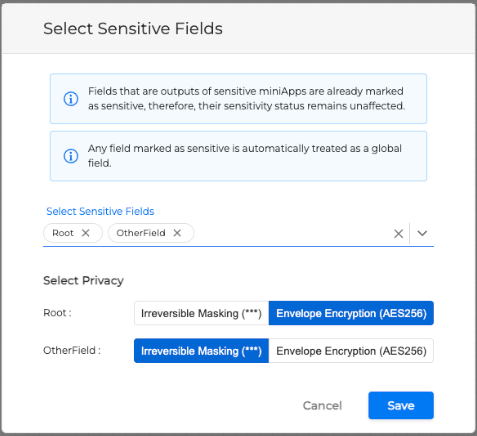
Sensitive fields privacy and encryption options through the Application Options menu
Improvements
-
UI/UX improvements (keyboard navigation, warnings)
-
Fail source validation and performance optimizations.
Orchestrator v1.28.0
Released: July 2025
|
US1 |
US2 |
EU1 |
|---|---|---|
|
August 5, 2025 |
August 11, 2025 |
August 6, 2025 |
Added
-
Support Legacy applications as fail sources in Event Handlers
-
Mini navigation window toggles on/off from the Canvas Settings for easier navigation
-
Show remaining Flowapps number as a popup warning notification
-
Return the status of asynchronous deployment
Fixed
-
Double clicking issue resulting in overwriting canvas
-
Anything else node is not highlighted
-
Other minor improvements and fixes
Orchestrator v1.27.2
Released: April 2025
|
US1 |
US2 |
EU1 |
|---|---|---|
|
Rolled-forward |
Rolled-forward |
Rolled-forward |
Updates
-
Security Updates
Orchestrator v1.27.1
Released: April 2025
|
US1 |
US2 |
EU1 |
|---|---|---|
|
Rolled-forward |
Rolled-forward |
Rolled-forward |
Added
-
Added Support for System Error Handling
Orchestrator v1.27.0
Released: March 2025
|
US1 |
US2 |
EU1 |
|---|---|---|
|
Rolled-forward |
Rolled-forward |
Rolled-forward |
Added
-
Add Zoom in/out and full view in Canvas
-
Improve error detail for external services unavailable
-
Long running tasks token expiration
-
Support Description and Labels during Application Import/Export
-
Minor fixes and improvements
For more information, go to Getting Started with Orchestrator.
Orchestrator v1.26.0
Released: February 2025
|
US1 |
US2 |
EU1 |
|---|---|---|
|
Rolled-forward |
Rolled-forward |
Rolled-forward |
Added
-
Highlight parts of Canvas based on the simulator Chat Dialog
-
Support of sensitive terms redaction
-
Support async deployment for legacy Applications
-
Support DateRange miniApp
-
Minor improvements and fixes
For more information, go to Getting Started with Orchestrator.
Orchestrator v1.25.0
Released: December 2024
|
US1 |
US2 |
EU1 |
|---|---|---|
|
Rolled-forward |
Rolled-forward |
Rolled-forward |
Added
-
Search option in Orchestrator's project list page
-
Users can now add Labels and Descriptions for each project
-
Support Asynchronous Deployments
-
Support Tag OCP Variables Collections
Fixed
-
Minor fixes and improvements
Orchestrator v1.24.0
Released:
|
US1 |
US2 |
EU1 |
|---|---|---|
|
Rolled-forward |
Rolled-forward |
Rolled-forward |
Added
-
Support of legacy apps on Canvas
-
Various improvements and fixes
Orchestrator v1.23.0
Released:
|
US1 |
US2 |
EU1 |
|---|---|---|
|
Rolled-forward |
Rolled-forward |
Rolled-forward |
Added
-
Log When the User Hangs Up (FAR HUP) Event
-
Support Deployment of Legacy Applications
Fixed
-
Minor Fixes and Internal Improvements
Orchestrator v1.22.0
Released:
|
US1 |
US2 |
EU1 |
|---|---|---|
|
Rolled-forward |
Rolled-forward |
Rolled-forward |
Added
-
Support legacy Apps when creating a new Application
-
Deploy of legacy Applications
-
Expose blocklisting fields
-
Deprecate underscores in field names
-
Option for declaring incoming attached data fields as sensitive
Fixed
-
Minor fixes and internal improvements
Orchestrator v1.21.0
Released:
|
US1 |
US2 |
EU1 |
|---|---|---|
|
Rolled-forward |
Rolled-forward |
Rolled-forward |
-
Introducing Sync/Async onDialogEnd handlers
-
UI improvements of Input/Output field modals
-
Minor improvements and fixes