.svg)
Agent VB Middleware 6.21.0
New Features
-
Automatic PCI Data Protection During Voice Biometric Enrollment - OCP VB Agent-side Authentication® enrollment and verification now automatically detect and set aside any recorded speech containing sensitive payment card data, protecting customers without extra agent effort. Enrollment reaches a quick initial checkpoint sooner, while additional safeguards ensure only clean, nonsensitive speech counts toward enrollment. When sensitive content can't be confidently checked, that portion is skipped, so it's never retained.
AGI Connector 4.23.1
Bugfixes
-
Call Recording on numbers using Gradual Traffic Assignment - For a phone number whose traffic is split across two applications by an app router, the decision to record a call and the application the call actually ran on were made independently. Where only one side of the split had Whole Call Recording enabled, most calls handled by the recorded application were not recorded, and some calls handled by the other application were recorded and filed under the wrong group. Both now follow the same routing decision, so recording matches the application that served the call at any traffic split.
Improvements
-
Ignore Errors now covers muting failures - When a group is configured to ignore call-recording errors, a failure to mute a sensitive segment no longer escalates to a critical error, so the call is no longer transferred or terminated because of it. Previously this setting covered only recording-start and un-mute failures. Note that an ignored muting failure means the recording is kept and may contain audio that was intended to be masked; each occurrence is written to the connector logs.
Alerting API 1.0.0
-
Manage Alerts Directly from OCP Conversational Insights® - You can now enable, view, and control alerts directly within OCP Conversational Insights®, so you no longer need separate tooling to stay on top of conversational metrics. This first release lets you configure alerts through the interface you already use to track performance. Alerting API
Audio Hub 7.3.2
Fixes
-
Correct Voice Used for Newest Omilia Voices - Requests for a specific voice from Omilia's newest voice family are now honoured. Previously, these requests were silently served with the deployment's default voice, so applications configured for one voice could be heard speaking in a different voice. Voice selection now behaves consistently across all supported voices.
-
Uninterrupted Streaming After Quiet Periods - OCP Conversational Text-to-Speech® streaming no longer fails on the first request following a period of low traffic. The connection to the speech engine is kept warm, and a request that fails before any audio has been played is automatically retried, so callers hear the full prompt instead of an error.
Chat Connector 8.18.1
Fixes
-
Reliable Sensitivity Flagging for Chat Input - Chat messages containing sensitive information, such as passwords or PINs, are now correctly flagged as sensitive so they're consistently masked in transcripts and logs. This resolves an issue where the flag wasn't always set as expected, strengthening privacy protection for customer conversations.
Security
-
Updated Embedded Components - The embedded Apache Tomcat runtime (10.1.57) and the Netty networking library (4.1.136.Final) have been upgraded to address published security advisories. No configuration change is required.
Copilot 1.12.0
New Features
-
Session pinning, renaming, deletion & search in Copilot Widget - Manage your chat history more easily: pin important conversations, rename sessions, remove ones you no longer need, and search across chat titles to find a conversation fast.
-
Self-Learning Dashboard
Improvements
-
More reliable chat history and onboarding journey.
-
Smoother user management.
-
Clearer tool configuration guidance - The tool configuration screen now highlights proven workflow patterns to help you set up agent tools faster.
-
Better Knowledge Base uploads - FAQ documents are now grouped more clearly, and uploading a partial batch of FAQs is smoother.
-
Improved persona setup - The persona editor now pre-fills detected persona details, reducing manual setup.
Copilot 1.13.0
New Features
-
Fork Chat Sessions - You can now fork an existing Copilot chat into a new session. Explore a different path without losing the original conversation, and keep working from a clean branch of the same history.
-
Richer Agent-Proven Workflow Review - Agent-proven recipes now show the conversation alongside each desktop step, and explain in plain language why a detected recipe is not yet ready to replay.
-
Default Omilia Voice for New Self-Learning Agents - Newly created Self-Learning applications are configured with an Omilia Global TTS voice by default, so first voice tests sound polished without extra TTS setup.
-
Simpler RingCX Connection - RingCX project setup now accepts an account ID, with a more reliable authorization flow and clearer success or error feedback in the connection popup.
Improvements
-
Smoother Voice Test Waiting States - Pending indicators in Self-Learning voice mode fade in with light motion, so short waits feel less abrupt during testing.
-
More Reliable Knowledge Base Answers - Concierge agents are less likely to refuse in-scope FAQ questions when the knowledge base covers a broad set of topics, so callers are routed to the right knowledge more consistently.
-
Faster Call Ingestion - Call assessment during ingestion runs more efficiently under load, so new conversation data is ready sooner.
-
More Reliable Large Knowledge Base Publishing - Large knowledge bases now publish in smaller steps with clearer progress during Self-Learning deploy, reducing timeouts on bigger projects.
Fixes
-
Stronger Privacy in Call Assessment - Pre-redaction personal data is no longer retained in call assessment storage.
-
Reliable Agent Assist Navigation - Opening Agent Assist now takes you to the correct destination again.
-
Cleaner Agent Loading Experience - Agents that already have content no longer flash the first-time ingestion animation.
-
More Stable Concurrent Updates - Background processing and UI edits are less likely to overwrite each other when they run at the same time.
-
This release includes security updates.
Copilot 1.14.0
New Features
-
Playbook Test Coverage - The Self-Learning Testing view now shows how much of a playbook is covered by tests, and where the gaps are. You can see at a glance which policies, entities, and identity items still need scenarios before you ship.
Improvements
-
More Reliable Large Knowledge Base Publishing - Large knowledge bases publish more reliably during Self-Learning deploy. Publishing is paced so the platform gateway is less likely to time out, and deploy waits longer for ingestion to finish before publish starts. Deploy progress stays on screen for longer jobs instead of closing after about a minute or after a brief idle poll.
-
Clearer Chat History Errors - If Copilot cannot restore a previous conversation, you now get a specific error instead of a generic failure, so it is clearer what went wrong.
Fixes
-
Complete Group Reset Cleanup - Resetting a group now removes the stored files that reset actually wrote, so leftover data does not linger after a reset.
CoPilot 1.15.0
Improvements
-
The group you choose in Settings is now the group used for new conversations.
-
Your selected group stays selected after a conversation starts.
-
Scrolling on the Copilot home and onboarding screens works correctly with long conversations, and embedded layouts resize properly.
-
Administration errors now show the specific reason returned by the service, and Self Learning setup operations are handled by the dedicated Self Learning service.
-
Platform maintenance: health checks report the running version and database upgrades are more resilient. No new end-user chat capability in this release.
Deployment Service 1.6.0
Improvements
-
Extended Locale Support - Eighteen new locales are now supported: Norwegian (Norway), Swedish (Sweden), Spanish (Peru, Mexico, Colombia, Chile), German (Switzerland, Austria), English (Philippines, India), Filipino (Philippines), Japanese (Japan), Chinese (Mainland), Cantonese (Hong Kong), Malay (Malaysia), Thai (Thailand), Indonesian (Indonesia), and Hindi (India).
-
Full Application Cache Resynchronization - A new endpoint rebuilds the cached application data (registries, variables, tags) for all applications from the source of truth. This is a recovery measure intended for exceptional situations where the cache is lost or holds corrupted data, for example after a cache layer scaling operation, and is not part of normal deployment or day-to-day operation. It should be used only when a cache inconsistency has been confirmed.
-
TTS Model Configuration Validation - The deployment service now validates the text-to-speech model setting in application configuration at deployment time, catching invalid values early instead of surfacing them as runtime speech failures.
Dialogs API 3.3.0
New Features
-
Accurate Usage Tracking for Recording Downloads - Downloads of call recordings are now tracked to support precise, transparent billing across your account.
Improvements
-
Accurate Call Volume Counts for High-Volume Accounts - Call counts and related insights now display correctly for accounts with more than 10,000 calls, keeping large-volume reporting accurate and reliable.
DiaManT 10.45.0
New Features
-
Agent-supplied ASR/DTMF grammar override - When a DiaManT agent's action is an Ask, and it returns its own speech and/or DTMF grammar, DiaManT uses that grammar instead of the default configured agentic grammar.
Fixes
-
Intent removal fix - Fixed a bug where a
remove-intenteffect targeting the tail position (queue="tail") removed the entire intent stack instead of only the tail intent. Now only the targeted intent is removed; other intents in the stack are unaffected.
Diamant 10.46.0
New Features
-
Barge-In support for Agents: users can now interrupt an AI agent mid-response, consistent with standard voice interaction behavior.
-
Per-Agent Speech Recognition Tuning - Applications running several voice agents can now set separate speech recognition rules and boosted vocabulary for each agent and language, instead of sharing one configuration across the whole application. This makes it easier to keep recognition accurate for agents that handle distinct vocabularies, such as product names or account terms, without affecting other agents in the same application.
Improvements
-
More consistent intent confidence handling for data model inputs.
Hybrid Turn Detection 2.1.0
New
Hybrid turn detection uses audio and text cues to label end-of-turn in customer–agent interactions. This service reduces average dialogue duration and improves the user experience by minimising wait time.
Insights 1.26.15
This release contains internal and administrative updates only.
Integration Configurations 1.13.0
New Features
-
Audit events - Configuration changes are now emitted as audit events, so administrative activity is recorded centrally and the affected asset is visible in the audit trail.
-
Bring Your Own Key (BYOK) - Stored credentials can be encrypted with a customer-supplied key, with automatic expiry and scheduled cleanup of stale credentials.
-
RingCentral SMS channel configuration is now managed in Integration Configurations rather than in miniApps.
Improvements
-
Access-control policies for the Integration Admin Area, Viewer, Developer, Maintainer and Owner roles are now provisioned automatically across environments instead of by hand.
-
Whole Call Recording redaction supports two additional PII entity types: ROUTING_NUMBER and SERVICE_CODE.
-
The legacy Twilio number-purchasing integration has been removed; number provisioning is handled entirely by Voxbone.
Security
-
Third-party components were updated to clear known vulnerabilities, including Spring Framework, Apache Tomcat, Netty, Log4j2 and the bundled Swagger UI. This covers five CRITICAL and a number of HIGH severity advisories.
Summary
Integration Configurations 1.13.0 adds audit-event reporting, customer-managed credential encryption and RingCentral SMS channel configuration, automates access-policy provisioning, retires the legacy Twilio integration, and applies a broad round of security updates.
Liveness Detection 6.1.1
Improvements
-
Change the logic so that the first 3 sec of an audio chunk, which is duplicated, are not counted in the overall average score.
-
New calibration values for the model 3.1.0
OCP NLU 1.16.0
Improvements
-
Larger File Uploads for Training and Evaluation - Training and evaluation file uploads now support files up to 15 MB, up from the previous 10 MB limit, giving you more room to work with bigger datasets.
-
Clearer Snapshot List Layout - Fixed a display issue where the snapshot list could overlap the Cancel and Create buttons, so both stay visible and clickable.
-
Non-Latin Character Support in Context Rules - Context rule matching patterns now accept non-Latin characters, such as Cyrillic script, directly from the console, matching what was already available through the API.
-
Cleaner Model Import Error Handling - When linking a model to an existing artifact fails because of a domain mismatch, the system no longer leaves behind a stray application, keeping your workspace free of unwanted leftovers.
-
Recover from Stuck App Checkouts - You can now unblock and delete an application that's stuck mid-checkout or mid-deletion because its underlying resources were already removed, so you're not left waiting on an unrecoverable state.
-
Cross-Validation Results Travel With Your Model - Exporting, importing, or creating a snapshot of a model now automatically carries its cross-validation results along with it, so validation metrics move with the model instead of being left behind.
-
OCP Console® Overhaul, Phase Two - The OCP Console® continues its refresh with updated modals, drawers, input fields, and data tables for a more consistent look and feel across every section. The new experience can be turned on or off through a feature flag, so you control when you switch over.
-
Simplified Deployment Notifications - Notifications about inactive NLU deployments scheduled to stop are now grouped into a single message per user instead of one per application, with clearer wording letting you know deployments will stop in 24 hours.
-
Clearer Limit Messages for Models and Apps - When you reach a model or application limit, the message now tells you specifically whether it's your account limit or your group's limit, and who to contact, so you know exactly how to proceed.
-
More Reliable xPack Deployments - xPack deployments now check that required components are ready and configurations are in sync before proceeding, and prevent duplicate deployments of the same version, reducing failed or conflicting updates.
OCP NLU 1.17.0
New Features
-
Multi-Intent Recognition Expands to More Languages - Multi-intent recognition, previously limited to English, now extends to Greek, Spanish, German, and French, letting the system detect multiple customer intents in a single utterance across more languages.
-
Recognition accuracy for Greek is also improved with a new encoder ideal for large Greek datasets.
Improvements
-
Consistent Intent Selection Policy After Snapshot Updates - When you switch a running application to a new model snapshot, its intent selection policy now updates automatically to match the new snapshot. Previously, the application kept an outdated policy until you recreated it; scoring results now reflect the current snapshot's policy immediately.
Fixes
-
Resolved issue on working status of applications in both redis issues and large amount of ml models.
Orchestrator 1.36.2
Fixes
-
Restored Volume and Rate Controls in Text-to-Speech Configuration - Some text-to-speech configuration screens stopped showing volume and rate settings for certain locales, so changes could not be saved. Volume and rate controls now display correctly every time, so you can configure them without interruption.
Orchestrator 1.36.3
New Features
-
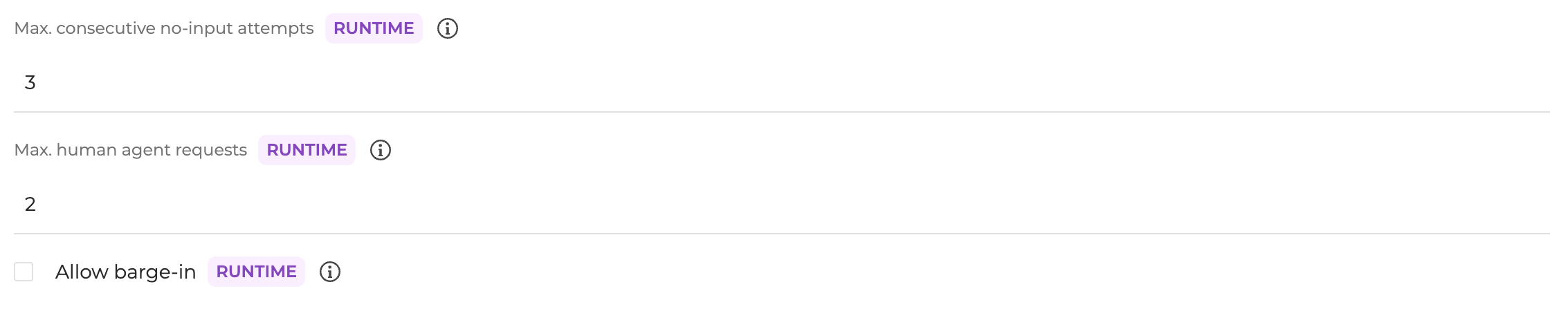
Configurable No-Input and Agent-Transfer Thresholds - You can now control how many consecutive silent responses or agent-transfer requests a caller can make before the conversation ends, directly from the agent configuration. Sensible defaults apply automatically if you don't set your own, and administrators can also disable a threshold entirely by setting it to zero. This gives you finer control over when a conversation ends or escalates, improving the experience for callers who stay quiet or repeatedly ask for a human agent.
-
Longer Agent Descriptions for Better Context - Agent descriptions now support up to 1,000 characters (previously 255), letting you add richer context in the console. More detailed descriptions help the Concierge make more accurate routing decisions among your agents.
Pathfinder 1.9.4
Improvements
-
Faster Response Times During High-Traffic Periods - Response times stay consistently fast during bursts of heavy concurrent usage, so authentication, search, and retrieval actions remain smooth even at peak load.
Redaction Service 0.4.0
Fixes
-
Reliable Handling of Unprocessable Call Recordings - Recordings that previously became stuck during automated processing, including very short audio clips, are now handled correctly so they no longer go missing from your exports.
-
Expanded PII Redaction Coverage - Redaction configurations now accept routing numbers and service codes as protected fields, previously rejected with an error, giving you more control over the sensitive information your recordings redact.
-
Consistent Number Formatting in Spanish Transcripts - Numbers in Spanish-language transcripts are now written out in words, matching the format already used for English, so transcripts read consistently across languages.
-
Complete Audio Transcription Coverage - Transcripts generated from recorded calls no longer drop segments of the audio, ensuring the full conversation is captured accurately.
-
Consistent PCI and PII Redaction Behavior - Redaction settings for payment card and personal information now behave consistently with what the configuration screen describes, so turning PCI or PII redaction on or off reliably applies the expected protection.
Self Learning Agents 1.15.0
New
-
Test results can now suggest concrete improvements, which you can review as a diff and apply to the test or the agent playbook.
-
Accepted learned FAQs appear as Live, while processed items awaiting publication remain Ready.
-
Playbook sections that were previously empty can now be edited directly.
-
Generated automations can be traced back to the calls they were built from.
Improvements
-
Call processing produces results sooner and stays predictable under concurrent load.
-
Sensitive call data stays protected even when transcription or redaction fails, and redaction no longer risks altering unrelated values.
-
Reliability improvements across group reset, recording encryption, large knowledge-base publishing, RingCX connection completion, and incremental playbook rebuilds.
STT 8.9.0 Release
New Features
-
Added
--prepare-bgrammarCLI flag to omCompiler, enabling partners to generate.bgrammarfiles directly during compilation
Improvements
-
More Reliable Number Transcription for GENERIC ASR (logos models) - deepASR® features an improved post-processing mechanism that converts spoken numbers (zero through twelve, including 'oh' for zero) into digits with higher accuracy.
-
More Transcription for GENERIC ASR (logos models) - Improved GENERIC ASR (logos models) word capture to ensure complete final transcriptions.
Fixes
-
Proper deletion of wav files - Fixed a bug where temporary
.wavfiles were not deleted post-upload when delayed upload was enabled per-request while disabled globally. -
Fix duplicate final step - Fixed a race condition during audio stream shutdown that caused duplicate final transcription result reports to be emitted.
-
Dynamic grammar compilation - Fixed a segmentation fault occurring during dynamic recipe compilation via the v2 endpoint.
Testing Studio 1.22.0
New Features
-
Routing Verification for Concierge Agent Tests - Tests in OCP Testing Studio® can now confirm that a Concierge Agent routes conversations to the correct destination, not just that the reply text matches. Testers select the Routing Param check on a test run, and OCP Testing Studio compares the actual routing decision against the expected one, catching routing regressions that a text-only comparison would miss.
-
Re-run Only Failed Test Cases - After a test run completes, you can now start a new run that repeats only the test cases that failed, instead of retesting the whole suite. The follow-up run appears in run history like any other, saving time when checking a fix.
Improvements
-
Automated Route Testing for Concierge Agents - Generate test scenarios automatically for every routing destination a Concierge Agent supports, then verify and capture the actual route taken during a run. This speeds up coverage of routing logic without writing each scenario by hand.
-
[Unit Testing Agent] Open-Ended Goal Checks for Test Scenarios - Test scenarios can now include a plain-language goal, such as confirming an agent offers a discount, instead of requiring an exact-match answer. Results show whether the goal was met, giving more flexible and realistic coverage of agent behavior.
-
[Unit Testing Agent] Simplified Scenario Checks - Each test scenario now allows only one route check, one answer check, and one goal check, preventing conflicting expectations and keeping test results clear and unambiguous.
-
[Unit Testing Agent] Review and Readiness Guidance for Test Scenarios - Scenario cards now show at a glance what is still missing, such as an expected answer, route, or review confirmation, and let reviewers mark AI-generated scenarios as verified independent of whether the test passed. This makes it easier to track which scenarios are ready for use.
-
[Unit Testing Agent] Clearer Partial Test Results - Test results now distinguish passed, partially passed, failed, and unchecked outcomes instead of a simple pass or fail, making it easier to see when a scenario partly succeeded, such as routing correctly but returning the wrong answer.
-
[Unit Testing Agent] Unified Inputs Column for Test Data - Test scenario key-value inputs now export and import through a single Inputs column in CSV files, with automatic detection of comma, semicolon, or tab separators, simplifying test data exchange with other tools.
-
[Unit Testing Agent] Agent Filtering by Group - When testing agents, you can now filter the agent list after selecting a group, making it faster to find the agent you want without scrolling a long list.
Fixes
-
More Reliable Test Runs Under Load - Test runs with several test cases executing at once no longer intermittently fail with dialog-not-found errors, improving reliability for larger, concurrent test executions.
-
Accurate Detection of an Agent's Final Response - Test validation now correctly recognizes an agent's closing response, preventing scenarios from failing when the agent legitimately hands back control at the end of a conversation.
-
Correct Touch Detection in Generated Test Cases - Test cases generated from recorded conversations now correctly mark button-tap steps even when the recorded text differs from the button label only by capitalization or spacing.
-
Fewer Failures in Large Parallel Test Runs - Large test suites split across parallel workers no longer fail intermittently due to internal file conflicts during execution.
-
This release includes security updates.
TTS 3.2.0
Spanish pronunciation & verbalization fixes (es-US, es-CO)
-
Chained spelled-out letters are now clearly separated.
-
Capitalized abbreviations opening a sentence are handled correctly.
-
Unit designators after address abbreviations are read properly as part of the address.
Colombian Spanish (es-CO) number & currency fixes
-
Decimal values with units read correctly: "2,5Gb" → "dos coma cinco gigabits" (previously "veinticinco gigabits").
-
Numbers written with a period are no longer mistaken for dates.
-
Amounts under one unit read as the subunit: "$0,01" → "un centavo" (previously "signo de dólar cero coma cero uno").
-
Decimal numbers using the Colombian "," separator are read as "coma" instead of "punto".
Lexis voices only: en-US, en-GB, fr-CA, es-US, es-CO
-
Punctuation is no longer preceded by an audible gap.
-
Long runs of the same repeated digit are correctly handled and do not result in hallucinated audio.
TTS 3.2.1
Stability (Lexis voices)
-
GPU crashes observed under sustained high-concurrency traffic no longer occur.
-
If a GPU-level error does happen, the service now reports itself as unavailable instead of continuing to accept traffic it cannot serve, so the affected instance is restarted automatically and recovers on its own. Previously, it stayed in service, failed every request, and needed a manual restart.
-
The hallucination guardrail is now on by default. Audio that runs far longer than the input text can justify is cut short, and the prompt is retried. The retry can be preceded by a short apology (for example, "Sorry, let me try again."), configurable per deployment.
Verbalization
-
"Ave." is now read as "avenue", including when capitalized. The same fix covers other capitalized address abbreviations such as St. and Blvd.
-
Numeric sequences are now read three digits at a time, regardless of whether they are repeated or not.
-
Telephone numbers are read digit by digit in all supported locales, with two-zero groups spoken as multiples: "800" as "eight hundred", a trailing "1400" as "fourteen hundred".
Prosody
-
Unexpected pauses in the middle of a sentence, most noticeable in Greek, are reduced. Where a long sentence still has to be broken up, the break is placed at a comma instead of in the middle of a clause, so the words either side of the break are no longer run together.
-
This is a mitigation rather than a complete fix. The underlying cause, sentence length being estimated before the text is verbalized, requires a structural change to the engine and is planned for a following release.
Voice Biometrics 1.17.5
-
This is a targeted hotfix for BioStore, addressing a database schema configuration issue and a startup issue affecting certain environments.
Webchat 2.38.0
Improvements
-
Clearer Agent Timeout Messaging - When a request to connect with an agent times out, the chat now shows a clear message explaining that an agent is unavailable, instead of ending the conversation without explanation. This helps users understand what happened and know what to do next.
Workforce AI 2.5.6
Project-Based Workspace
-
Workforce AI now organizes your work into Projects. Each project has its own categories, assessments, results, and settings, making it easy to run separate QA programs by skill, language, client, or business unit. Navigate between Categories, Assessments, and Settings using the new tabbed project view.
Quality Dashboard & Analytics
-
A comprehensive results dashboard is now available for each assessment. View aggregate KPIs, per-agent leaderboards, category breakdowns, and trend charts at a glance. Drill down through multiple detail levels, from overall performance to individual agent and category breakdowns, using the new multi-level dashboard views and agent detail drawer.
Heatmap Visualization
-
A new interactive heatmap provides at-a-glance performance patterns across agents, categories, and time periods.
Improved Category Management
-
15 new evaluation templates (7 binary, 8 scored) replace the previous set, covering more use cases out of the box.
-
Add result explanations to your categories, describe what Pass/Fail means or what each score (1–5) represents, to improve LLM classification accuracy.
-
Scored (1–5) categories can now be selected when creating assessments.
-
Category and assessment names are now unique per project, so you can reuse names across different projects.
-
Category names are validated for allowed characters.
Assessment Enhancements
-
Enable sentiment analysis and summarization directly when creating an assessment.
-
Assessment status is now more precise: "Stopped" is clearly distinct from "Completed", and paused assessments can be resumed.
Upload & Batch Management Redesign
-
Name your batches at upload time for easy identification and filtering.
-
The upload form is now organized into clear steps with inline filename rules, live file summary (count, size, duration, date range), and per-file review before submitting.
-
The batches list features a card-based layout with visual status indicators and expandable inline details.
Navigation & UI Improvements
-
Breadcrumb navigation is now available on every page, so you always know where you are and can navigate back up the hierarchy.
-
Updated modals, drawers, input fields, and data tables for a more consistent experience across the platform.
Bug Fixes
-
Project list now refreshes immediately after creating a new project.
-
Archived assessments are no longer shown in the project assessments list.
-
Resolved dialog processing failures related to v2 scripts and token expiration.
xPacks 1.19.2
New OCP xPacks
-
fr-BE Universal deepNLU® xPack v3.0.0
xPacks 1.20.0
New OCP xPacks
-
pt-PT Universal+ deepNLU® xPack v3.15.0-
The pt-PT Universal xPack has been enhanced with Portuguese address recognition, delivered as a separate pt-PT Universal+ xPack.
-
Fixed OCP xPacks
-
en-US Universal deepNLU® xPack v3.18.0-
Improved recognition accuracy for Alpha, Alphanumeric, DayPeriod, DayOfMonth, CONVENTIONAL, and SentimentDescriptor entities.
-
The Alphanumeric entity now returns both readings of an ambiguous spoken number group when the caller is interacting with an Alphanumeric miniApp. For example, "a b fifty four a b" returns "a b 54 a b" and "a b 50 4 a b".
-
An alphanumeric value spoken with a separator such as "dash" or "hyphen" is no longer truncated at that point. Recognition continues to the end of the value, and the separator itself is not returned as part of the value.
-
When a separator word such as "dash", "hyphen", "underscore", "dot", "slash" or "backslash" was spoken between two spelled letters, the letter before the separator was dropped from the value. All spelled letters are now returned.
-
In the en-US Alpha miniApp, "AM" no longer misfires the DayPeriod entity when the two letters appear together, which previously also corrupted the returned Alpha value.
-
SentimentDescriptor polarity is now flipped correctly for the reported negation patterns expressed as a contraction, for example "I wouldn't appreciate that" and "I don't like this product". The entity is also no longer returned for phrases that carry no sentiment, such as "I would like".
-
CONVENTIONAL=hold and CONVENTIONAL=notAvailable are now returned consistently regardless of the order in which they are spoken in the utterance.
-
-
es-US Universal deepNLU® xPack v3.11.0-
Tuning in the recognition of Alphanumeric, DIALOGACT, CONVENTIONAL, and MonetaryCurrency entities.
-
New support for the SentimentDescriptor entity. Words and phrases expressing a positive or negative attitude are now recognized, and the detected polarity is returned as the value of the entity.
-
NLU support for date range recognition. Utterances that state a period, for example "desde el primero de enero hasta el dos de marzo", now return the StartDate and EndDate entities (under the
dateRange_miniAppNLU tag). -
Multi-word phonetic letter references are now recognized generically, without requiring a dictionary entry for each phrase. For example, "s de sao paulo" returns s(sao paulo). Existing dictionary-based references continue to work.
-
Wider coverage for DIALOGACT=RESTART, including imperative forms such as "regresa al principio" and "comience de nuevo".
-
At a suggestion step in a Text miniApp, an answer that contains a modal verb or a month is no longer misread as a yes or no reply. The original text is preserved instead.
-
In the yes or no re-ask context (prompt: ¿Qué más puedo hacer por usted hoy?), "no creo" no longer returns DIALOGACT=CLOSING. Explicit closing phrases such as "adiós" and "no necesito más ayuda" are unaffected.
-
-
uk-UA Universal deepNLU® xPack v3.9.0-
Enhanced DIALOGACT entity recognition.
-
-
uk-UA Banking deepNLU® xPack v4.4.0-no_intents-
Tuning for recognition of the following entities: ACCEPT, CONVENTIONAL, DIALOGACT, and REJECT.
-
Improved DIALOGACT=REJECT recognition accuracy on ambiguous or poorly-transcribed utterances, which previously triggered a definitive entity instead of falling through to No Interpretations.
-